



• Paris summit draft statement says Washington would support multinational force in case of renewed Russian attack
• European-led force to be deployed in Ukraine after ceasefire
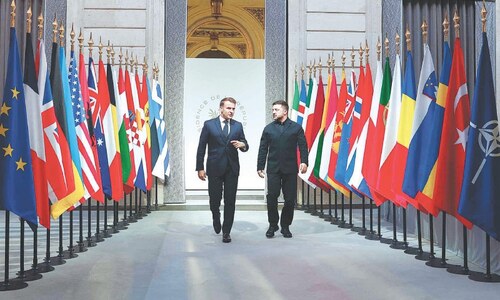
PARIS: European allies of Ukraine, along with the United States, have agreed on “robust” security guarantees that would see Washington lead a truce monitoring mechanism once a ceasefire is reached, French President Emmanuel Macron said on Tuesday.
Macron, British Prime Minister Keir Starmer and Ukrainian leader Volodymyr Zelensky signed a declaration of intent that foresees Britain, France and other European allies deploying troops on Ukrainian territory after a ceasefire.
Macron said after the meeting in Paris that the moves represented “robust security guarantees for a solid and lasting peace”, hailing an “operational convergence” among allies including the United States.
The security guarantees are “the key to ensuring that a peace agreement can never mean a Ukrainian surrender and that a peace agreement can never mean a new threat to Ukraine” from Russia, Macron said.
Washington would commit to “support” a European-led multinational force — deployed in Ukraine after any ceasefire — in case of a new attack by Russia, he added.
Against the background of tensions between Europe and Washington on Greenland and Venezuela, US envoy Steve Witkoff, who was present at the talks in Paris, said “a lot of progress” had been made.
Allies have “largely finished” agreeing security guarantees for Ukraine “so that the people of Ukraine know that when this ends, it ends forever”, he said, flanked by President Donald Trump’s son-in-law Jared Kushner.
Witkoff said that “land options” will be the most “critical issue” and “hopefully we will be able to come up with certain compromises with regard to that”.
Starmer said following a ceasefire, the UK and France will establish “military hubs” across Ukraine and “build protected facilities for weapons and military equipment to support Ukraine’s defensive needs”.
But he warned: “We can only get to a peace deal if (Russian President Vladimir) Putin is ready to make compromises. Putin is not showing he is ready for peace.”
“This only hardens our resolve.”
Merz on Germany’s role
Chancellor Friedrich Merz said German forces could join a multinational force to monitor a ceasefire, but based on territory bordering the war-battered country.
“Germany will keep contributing politically, financially and militarily. This could, for example, include deploying forces to Ukraine on neighbouring Nato territory after a ceasefire,” he said.
Once a US-backed monitoring force is agreed, the German government and parliament “will decide on the nature and extent of a German contribution”, he said.
For now, Berlin was “not ruling anything out”, Merz said in Paris.
Germany, with its history of war and the Holocaust, has long been more reluctant than many of its Nato allies to deploy forces abroad.
But Merz has signalled continued strong support for Ukraine, sharply raised German defence spending and announced plans to build up the Bundeswehr into Europe’s strongest conventional army.
His suggestion of deploying German troops to neighbouring Nato territory did not go as far as France and Britain, which offered more explicit promises of support.