




Kathmandu, Nepal – Pabit Tandukar was shouting slogans against Nepal’s government outside the country’s parliament building in the capital Kathmandu when he felt sharp pain cutting through his leg.
The 22-year-old university student was taken to the trauma centre of Kathamandu’s Bir Hospital on Monday, where doctors confirmed he had been hit by a live copper bullet.
“We were there for a peaceful protest. They were initially firing tear gas at us and we were pushing back. Suddenly, I was shot,” Tandukar told Al Jazeera.
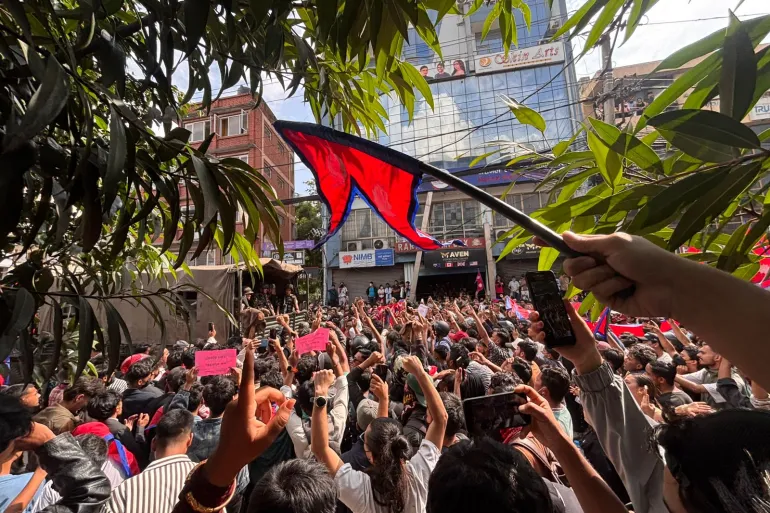
At least 19 protesters were killed, and hundreds – like Tandukar – were injured after security forces fired live ammunition, rubber bullets and tear gas shells at youth agitators on Monday, after what began as a peaceful protest descended into violent clashes with law enforcement officers.
The killings have pushed Nepal into a political crisis. Home Minister Ramesh Lekhak resigned from the position on Monday evening, claiming moral responsibility, and on Tuesday, Prime Minister KP Sharma Oli resigned.
But the thousands of young people who hit the streets of Kathmandu and other cities in Nepal on Monday, as part of what the organisers have called a Gen-Z movement, are demanding more – a dissolution of parliament and new elections.
The protests have erupted amid growing criticism of alleged corruption, and anger over perceptions that the families of the country’s ruling elite – including leading politicians – live lives of relative luxury while Nepalis struggle with a per capita income of less than $1,400 a year.
Then, the government last week banned 26 social media platforms, including Facebook, YouTube and X, after they missed a September 3 deadline to register with the country’s authorities under a controversial new law. That ban further raised anger against the government among young, digitally native Nepalis, though the government said it was trying to stop the use of fake online identities to spread rumours, commit cybercrimes, and disturb social harmony.
By Tuesday, though, that simmering anger and the protests it led to had exploded into even more violence, with the killings of civilians by security forces becoming the lightning rod galvanising youth, who returned to the streets for a second day in a row.
“The government should not have fired bullets at students,” Tandukar said.
![A protester marching with the national flag on a Kathmandu street [Samik Kharel/ Al Jazeera]](https://www.aljazeera.com/wp-content/uploads/2025/09/4-1757411109.jpeg?w=770&resize=770%2C701&quality=80)
‘This one is for KP Oli’
Joining the protest near parliament on Monday, Megraj Giri* aimed a stone at a CCTV placed on the northern wall of the legislature building in New Baneshwor, in the heart of Kathmandu.
The government had imposed a curfew – which was extended on Tuesday – but Giri was defiant. “This one is for KP Oli,” he shouted, referring to the prime minister, as his missile shattered the camera.
That’s not how the organisers of the protest had imagined things would turn out.
“We planned a peaceful protest with cultural events and fun,” said Anil Baniya of Hami Nepal [translated as We Nepal], one of the organisers, speaking to Al Jazeera.
“During the first few hours, it went as planned, until some external forces and political party cadres joined in the protest and agitated the armed forces and pelted stones.”
Organisers have not named specific parties or external agents whom they blame for instigating the violence. But it was when some protesters began to climb the walls of the parliament complex to enter that security forces fired back, Baniya said.
Some of the protesters who were hit were schoolchildren still in their uniforms – it is unclear whether they were among any of the 19 who were killed.
The Kathmandu District Administration Office imposed curfew in that part of the city, and Nepal deployed its army. Armed forces also entered the Civil Service Hospital near Parliament to capture protesters, and shot tear gas, causing chaos in the facility. Toshima Karki, a doctor turned member of parliament, was at the hospital helping the injured when she witnessed the attack.
“No matter what, the government should not have used bullets. They murdered young people,” added Baniya.
Until late on Monday night, videos also emerged showing armed police officers carrying out search operations in houses near the protest area.
Among those killed was Sulov Raj Shrestha, who was studying civil engineering in Kathmandu.
“He was always smiling and had a friendly behaviour,” Sudhoj Jung Kunwar, a friend of Shrestha, recalled, speaking to Al Jazeera. “I just found out; he had his GRE exams today.”
Kathmandu Engineering College, where Shrestha studied, posted on Facebook: “We mourn, we protest, we condemn…… Sulov…..your nation has failed you…”
Political analyst Krishna Khanal blames “sheer negligence” on the part of the government for the killings.
“The young people should have been handled well; even if they crossed the parliament building, there were other ways to control them,” Khanal told Al Jazeera.
The UN’s Office of the High Commissioner for Human Rights and Amnesty International have both condemned the killings and called for transparent investigations into the events of Monday.
Speaking to the press late Monday night, Prithvi Subba Gurung, Nepal’s communications and information technology minister, announced the social media ban was being lifted.
But while the ban might be over, it is the killings on Monday that have now emerged as the principal issue inflaming passions on Nepal’s streets.
![High school students at Monday's protest in Kathmandu [Samik Kharel/ Al Jazeera]](https://www.aljazeera.com/wp-content/uploads/2025/09/1-1757411209.jpeg?w=770&resize=770%2C578&quality=80)
‘We demand mass resignation’
While the social media ban drew global attention, many protesters said their grievances run much deeper.
“We need to kick these old leaders out of power. We are tired of the same old faces,” said 27-year-old Yugant Ghimire, an artificial intelligence engineer who took part in Monday’s protest.
“The government is on a power trip, there is rampant corruption, no one is accountable,” Ghimire told Al Jazeera.
The movement has found support from sections of the political class, including Balen Shah, the mayor of Kathmandu, who is also a popular rapper.
Posting on social media on Sunday, Shah wrote, “Tomorrow, in this spontaneous rally, no party, leader, worker, lawmaker, or activist will use it for their own interest. I will not attend due to the age limit, but it is important to understand their message. I give my full support.”
Meanwhile, before Monday’s protest, Oli was largely dismissive of the movement. “Just by saying Gen Z, one is free to do anything, just by saying you don’t like it,” Oli said to an audience of his party cadres on Sunday.
That approach appears to have backfired on the government. On Tuesday, as the government imposed an indefinite curfew in Kathmandu, protesters defied those restrictions to set the homes of several politicians on fire.
Organisers of the protests have now released a set of “non-negotiable demands” which include the dissolution of the parliament, mass resignation of parliamentarians, immediate suspension of officials who issued the order to fire on protesters, and new elections.
Protest leader Baniya said the movement would continue “indefinitely until our demands are met”.
“We now have more of a duty to live up to the expectations of our friends who were murdered by the state,” said Baniya. “We need to topple this government, we demand mass resignation and we want them out. This is our country.”
