



SRI
  • WHO WE ARE
    • ABOUT SRI
    • WRITE FOR US
  • NEWS
    • Africa
    • Asia
    • Americas
    • Europe
    • Kashmir
    • Middle East
    • Pakistan
    • World
  • ARTICLES
    • BLOG
    • RESEARCH ARTICLES
  • INFOGRAPHICS
    • Constitutional Amendment
    • Covid-19
    • Dams
    • Economy
    • Environment
    • Fact of the day
    • Global Facts and Statistics
    • History through lens
    • Israel Attack
    • Kashmir
    • Learn the term
    • Middle East
    • Military
    • Nuclear
    • Pakistan
    • Personality
    • Quote of the day
    • Space
    • Theory Thursday
    • Today in history
    • Women in international world
  • WEB INFOGRAPHICS
  • CONTACT US
Font ResizerAa
SRISRI
Search
  • INFOGRAPHICS
  • WEB INFOGRAPHICS
  • ARTICLES
  • NEWS
    • Asia
    • Pakistan
    • Americas
    • Europe
    • Middle East
    • World
    • Ukraine crisis
Follow US
Copyright © 2024 Strategic Research institute
Middle EastNEWS

The Yemeni Crisis: More Complexity And Many Repercussions

SRI NewsDesk
By SRI NewsDesk Published January 5, 2026
Share
The Yemeni crisis: More complexity and many repercussions
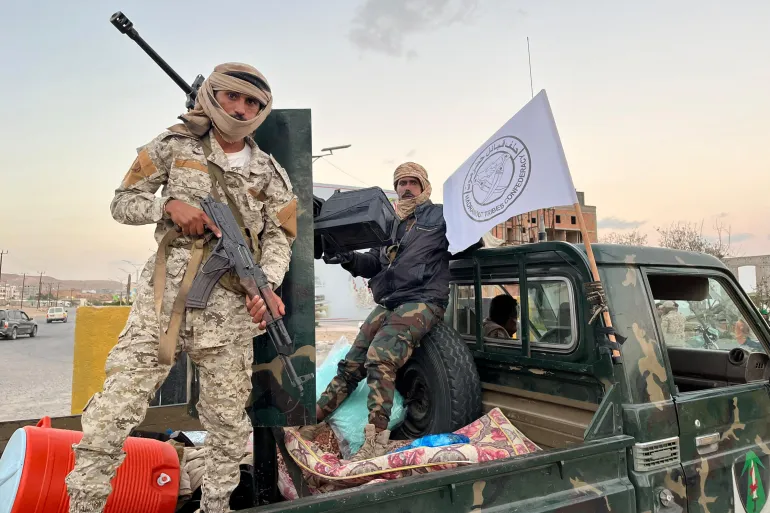
Yemeni forces took control of the Second Military Region Command on the outskirts of Mukalla, the capital of Hadramout, from the UAE-backed secessionist Southern Transitional Council, January 3, 2026

Events in Yemen are escalating quickly and dramatically, reaching the point of armed clashes erupting between the Arab coalition supporting the internationally recognised government in Yemen, led by Saudi Arabia, and the so‑called “Southern Transitional Council” (STC), backed by the United Arab Emirates.

Many view these developments as a natural outcome of a long, cumulative trajectory of complexities the country has experienced since the civil war erupted in late 2014, and the humanitarian and economic repercussions that followed.

External interventions had a profound impact in creating political and administrative chaos that intensified internal divisions and exposed what remained of the legitimate state to further weakness, culminating in the loss of its most important sovereign tools: unity of territory and decision-making. These developments and events add further complexity to an already complex picture, and Yemen will not be safe from their future repercussions.

On the other hand, others view the situation from another, less bleak angle. The strong reaction to the STC’s moves — on the part of the Yemeni president (chairman of the Presidential Leadership Council, or PLC) and, behind him, the Saudi‑led Arab coalition — is a new and important variable, completely different from the usual approach to many similar events. So, there is hope that these events and changes will mark a new phase that works to correct the imbalances and deviations that accompanied the Arab coalition’s intervention over more than a decade.

Watching carefully are the Houthi rebels in northern Yemen, who have remained silent, apparently waiting to see what these events will produce as they continue to strike at the unity of the components of the Arab coalition’s leadership and undermine the legitimate government. In any case, they realise that the eventual outcome will ultimately be in their favour. Therefore, the Houthis, according to multiple reports, are currently intensifying their military preparations, redeploying and dispersing their forces along the theatre of operations adjacent to contact points on the fronts: the northeast (Marib), and the southwest in Taiz and Bab al-Mandeb, preparing for zero hour.

So, what is the nature and background of this bilateral conflict between allies? Where have these events and developments led Yemen, and where will they lead it? And what are their implications for the future of the country and the region?

There is broad agreement that what is happening today is merely an initial result of a deep internal conflict of interests between the two main coalition states — Saudi Arabia and the UAE. Although most of this conflict remained hidden, its accumulations continued to roll and grow like a snowball.

To understand how matters reached this point of an explosion of conflict between allies, we must first understand the background of this rivalry and conflict.

In late March 2015, Saudi Arabia led a coalition of 10 Arab and Muslim countries to intervene militarily in Yemen — later it was called the Coalition to Support Legitimacy in Yemen, with the aim of restoring the authority of Yemen’s former legitimate president, Abd-Rabbu Mansour Hadi, from the grip of the Houthi coup forces.

At the outset, the coalition achieved major, tangible successes on the ground before differences began to emerge between the two main allies, Saudi Arabia and the UAE.

There is a widespread and well‑grounded belief that the UAE entered this war with a plan to achieve purely geopolitical and strategic interests. Some argue, however, that this was not necessarily the case at the beginning, but that it may later have turned to exploiting weakness, vacuum, and internal divisions in order to redraw its strategy anew in light of that.

On the ground, the UAE formed, trained, and financed local forces loyal to it, using them to achieve its own objectives, away from the coalition and the legitimate government. Within just two years of its intervention, it managed — through its own local forces — to impose control over all strategic maritime outlets along southern and eastern Yemen, reaching the western coast of Taiz governorate in the country’s southwest, where the strategic Bab al-Mandeb Strait lies.

TAGGED:Arab CoalitionMiddle East GeopoliticsSaudi Arabia–UAE TensionsSouthern Transitional Council (STC)Yemen Conflict
Share This Article
Facebook Twitter Email Copy Link Print
Previous Article Kashmir Adventure Club sets Winter Camping Record at Nilfery Meadows Kashmir Adventure Club Sets Winter Camping Record At Nilfery Meadows
Next Article 1 killed, 8 injured in IED attack on vehicle carrying cement workers in Lakki Marwat 1 Killed, 8 Injured In IED Attack On Vehicle Carrying Cement Workers In Lakki Marwat
Leave a comment

Leave a Reply Cancel reply

Your email address will not be published. Required fields are marked *

Your Trusted Source for Accurate and Timely Updates!

Our commitment to accuracy, impartiality, and delivering breaking news as it happens has earned us the trust of a vast audience.
268kLike
90.7kFollow
17.9kFollow
4.9kSubscribe
1kFollow

Popular Posts

Economic Cost Of War In Afghanistan

By SRI NewsDesk

IAEA Warns Israel-Iran Conflict Threatens Nuclear Facilities, Diplomacy

The head of the International Atomic Energy Agency (IAEA), Rafael Grossi, has warned that escalating…

By SRI NewsDesk

Defeated attempts to “destabilize” the nation, according to Burkina’s military government

More than 26,000 people, including troops, militia members, and civilians, have died in Burkina Faso…

By SRI NewsDesk

You Might Also Like

Iran remains unbothered by US threats
NEWSWorld

Iran Remains Unbothered By US Threats

• Judiciary orders no leniency against ‘rioters’ amid unrest • Trump vows Tehran will ‘get…

By SRI NewsDesk
Balochistan protesters demand action on Kech kidnappings
NEWSPakistan

Balochistan Protesters Demand Action On Kech Kidnappings

GWADAR: Leaders and workers from different political parties, along with civil society members, staged a…

By SRI NewsDesk
Israel defends ban on media access to Gaza
Middle EastNEWS

Israel Defends Ban On Media Access To Gaza

JERUSALEM: The Israeli government has told the Supreme Court that a ban on international media…

By SRI NewsDesk
Kashmiris observe right to self determination day with renewed resolve to continue struggle till achievement of this much-cheulrished birth right
KashmirNEWS

Kashmiris Observe Right To Self Determination Day With Renewed Resolve To Continue Struggle Till Achievement Of This Much-cheulrished Birth Right

MIRPUR (AJK)(Parliament Times) : Calling upon United Nations Organization to immediately move for implementation of the…

By SRI NewsDesk
Show More
SRI
Facebook X-twitter Youtube Instagram Linkedin

About Us


Strategic Research Institute (SRI) is a non-partisan, non-political and non-governmental research organization based in Islamabad. 

Top Categories
  • BLOG
  • INFOGRAPHICS
  • NEWS
  • RESEARCH ARTICLES
Useful Links
  • ABOUT SRI
  • CONTACT US
  • WRITE FOR US
Copyright © 2026
Strategic Research institute
 
Welcome Back!

Sign in to your account

Lost your password?