




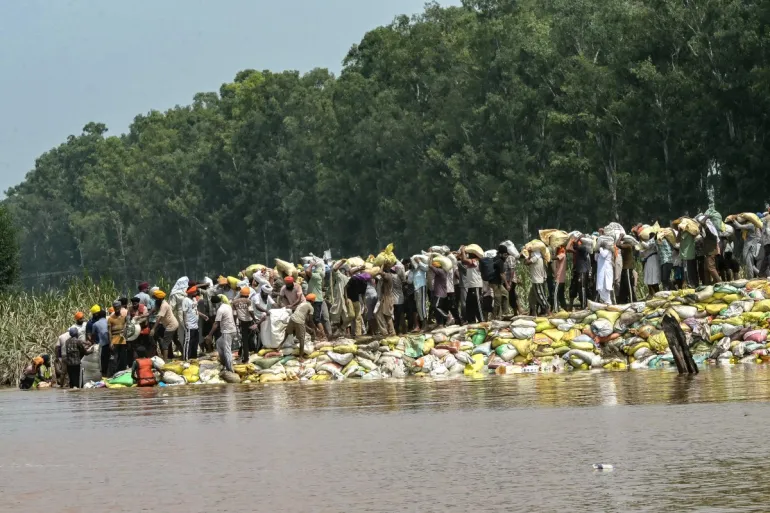
After taking multiple economic hits in his household, Gurvinder Singh, a 47-year-old farmer in Gurdaspur, in India’s Punjab state, took a million-rupee loan ($11,000) from a private lender to marry off his eldest daughter. He saved a portion of that and used it to sow 3 acres (1.2 hectares) of paddy.
He placed his bet on the high-yielding pearl variety of aromatic Basmati rice. A good sale would have given him an earning of nearly 1 million rupees per acre ($11,400 per 0.4 hectares).
But now, Singh’s pearl paddy grains lie submerged in floodwater, buried under layers of soil and sediment.
“I cannot afford this shocking flood at this time in my life. We are ruined,” Singh told Al Jazeera. “This year’s harvest was supposed to cover our debts. But this field is a lake now, and I don’t know how I will start again.”
Singh also had to temporarily leave his home, along with his wife and two children, after the devastating floods hit their village earlier this month. “What will I go back to?” he wondered.

‘A lasting repercussion’
Northern Indian states have been reeling under the impact of heavy monsoon rains, flash floods and swelling rivers that have submerged entire villages and thousands of hectares of farmland.
In Punjab, where more than 35 percent of the population relies on agriculture, the situation is particularly grim. Here, farmers are facing the worst floods in the last four decades, with large tracts of paddy fields inundated just weeks before harvest. The state cultivates rice in nearly two-thirds of its total geographical area.
Gurdaspur, where Singh lives with his family, has been among the worst flood-hit districts in a region that borders three overflowing rivers – Ravi, Beas, and Sutlej – following heavy rainfall in Indian-administered Jammu and Kashmir and Himachal Pradesh state.
At least 51 people have died due to floods in Punjab, and 400,000 more people have been displaced.
Singh’s field of paddy contributes to India’s $6bn worth of Basmati exports. Punjab alone accounts for 40 percent of the total production. Across the border, Pakistan’s Punjab province, also submerged in floods, accounts for 90 percent of the country’s Basmati output, generating nearly $900m.
Initial official estimates put the complete loss of crops in more than 450,000 acres (182,100 hectares) — almost the area of Mauritius — of farmland in India’s Punjab. Independent agricultural economists told Al Jazeera that the final impact of floods could be five times higher than the official estimate.
“The crop is completely spoiled, their machinery is submerged, and the farmers’ houses have washed away,” said Lakhwinder Singh, director of the Patiala-based Punjabi University’s Centre for Development Economics and Innovations Studies.
“Punjab’s farmers have to restart from scratch. They would require a lot of support and investment from the government,” Singh told Al Jazeera.
So far, the Punjab government – governed by the Aam Aadmi Party (AAP), which is nationally in opposition to Prime Minister Narendra Modi’s Bharatiya Janata Party – has announced a 20,000 Indian rupees ($230) allowance for farmers who lost their crops to flood. But that may be too little to deal with the monumental challenges that lie ahead for farmers, said Singh.
Nearly 6 percent of that basmati rice is shipped to the United States, which has slapped a 50 percent tariff on New Delhi. India has traditionally been protectionist towards its agricultural sector, which employs half of India’s population (the world’s largest) – a sticking point in trade negotiations with the administration of US President Donald Trump .
Singh warned the government of India against using the impact of the floods as leverage to liberalise policy to import food grains. “The government must not push the farmers under the bus to reduce the tariffs and get a deal with Trump,” he said. “These Punjab floods could have a lasting repercussion on the future of the agricultural economy.”

‘All we have is water’
The immediate and daunting challenge for Punjab’s farmers will be to get rid of the soil and sediment that have settled over their farmlands, agriculture experts have said.
Indra Shekhar Singh, an independent agricultural policy analyst, said that the extent of the damage could only be determined after the water receded from the fields. “There is excessive sedimentation and mud on farmers’ fields,” he told Al Jazeera. “Another problem is levelling the field, which is another cost, and readying it for the next season.”
In India, the monsoon or “kharif” crop makes up about 80 percent of the total rice production, which is harvested in late September to October. Now, experts say, Punjab’s farmers are racing against time to ready their fields for the next season’s crop, winter’s wheat, which must start by early November to avoid yield losses.
“Paddy fields are taking the worst hit in the floods,” said Shekhar Singh. “Unless there is a miracle, even the conservative numbers suggest heavy losses to farmers.
Other than the new diseases from floodwaters that may affect the standing crops, Shekhar Singh said that the farmers are also staring at a critical nutritional crisis for the Rabi season.
India’s farmers rely on urea, containing about 46 percent nitrogen, as their main fertiliser; the country is also the world’s largest importer of urea. But stocks have been dwindling: Urea stocks dropped from 8.64 million tonnes in August 2024 to 3.71 million tonnes in August this year.
This monsoon also saw panic buying of urea by farmers across several Indian states. Now, the floods have struck amid an underlying fear that fertilisers may fall short for the upcoming Rabi sowing. There has been a global surge as well in urea prices, rising from $400 per tonne in May 2025 to $530 per tonne in September.
“This would lead to black marketing for fertilisers in impacted states like Punjab, and adds to an existing problem of fake pesticides circulation,” added Shekhar Singh.
Punjabi University’s Singh said that farmers face a “prolonged economic crisis for them that will continue in the coming months”.
Meanwhile, Singh, the farmer from Punjab’s Gurdaspur, is pondering what the future holds for his family.
He had married off his daughter earlier this year to another farmer in Amritsar, one of Punjab’s biggest cities that borders Pakistan. Their farmland is submerged, too.
“I cannot travel to visit them even when we are suffering from the same disease,” he said, before reflecting on the tragedies confronting a region where two sides of a tense border are grappling with the same crisis.
“We were ready to fight a war for these rivers,” Singh said, referring to the hostilities between India and Pakistan earlier this year after an attack in Indian-administered Kashmir killed 26 civilians. India had suspended the Indus Waters Treaty, which distributes the six rivers between the nuclear-armed neighbours, in response – a move that Pakistan described as an “act of war”.
“All we have now is water,” Singh said.