




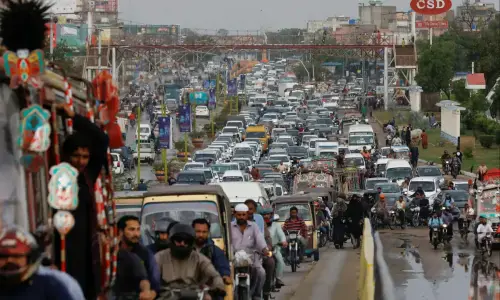
Pakistan’s population has crossed an estimated 257 million at midyear, placing it among the world’s most populous nations even as its fertility and growth rates continue to decline, according to a report released by the US Census Bureau on Tuesday.
Demographic databases, including projections by the US Census Bureau and the United Nations, show Pakistan’s population density at 333 persons per square kilometre, underscoring the scale of pressure on land and public services.
The data depict a country facing one of the most complex population transitions in South Asia — caught between rapid numerical expansion and slow human-development gains.
Despite decades of policy debate, Pakistan is still adding millions of people each year. Its annual population growth rate stands at 1.82 per cent, lower than in previous decades but high enough to keep total numbers rising steeply for at least another generation, the report said,
It added that the total fertility rate (TFR) — the average number of births per woman — has fallen to 3.25, yet remains well above the replacement level of 2.1, ensuring continued expansion through what demographers describe as population momentum.
At the same time, social indicators remain weak. Life expectancy at birth is estimated at 60.5 years, among the lowest in the region, while the under-five mortality rate stands at nearly 65 deaths per 1,000 live births, reflecting persistent shortcomings in maternal health, child nutrition, disease prevention and primary healthcare access, per the report.
Together, these figures underline the uneven nature of Pakistan’s demographic transition, in which family size is shrinking faster than improvements in health and longevity.
How Pakistan compares with its neighbours
A regional comparison highlights the scale of Pakistan’s challenge. India, now the world’s most populous country with about 1.46–1.47 billion people, has already crossed below replacement fertility, with a TFR of around 1.9.
While India’s absolute numbers will continue to rise for several decades due to its large youth cohort, its growth rate is slowing rapidly, and attention is shifting toward labour-force ageing, pension systems and productivity.
Bangladesh, often cited as a demographic success story, has pushed fertility down to around replacement level despite extreme land pressure. With a population of about 175–176m packed into one of the world’s highest population densities, Bangladesh has achieved sharp declines in child mortality and steady gains in life expectancy, largely through female education, family planning outreach and primary healthcare investments.
In contrast, Pakistan, with far more land per person, continues to lag on several of these indicators.
Afghanistan, at the other extreme, remains trapped in a high-growth, high-mortality cycle. With a population now estimated at over 44m, fertility remains above four births per woman, while child mortality and life expectancy are among the worst in the region.
Afghanistan’s demographic trajectory resembles Pakistan’s own profile from several decades ago, reinforcing how conflict and weak state institutions delay demographic transition.
A young country under immediate strain
Pakistan’s population structure remains heavily weighted toward the young. A broad base of children and working-age youth means that pressure on schools, universities, housing, transport and employment will intensify through the 2030s and 2040s. Even as fertility declines, the large size of today’s child and teenage population guarantees continued high demand for jobs and public services for decades.
Economists warn that without sustained economic growth and large-scale job creation, this youth bulge could become a source of long-term instability rather than a demographic dividend. Urban centres are already showing the strain through informal housing expansion, transport congestion and widening access gaps in health and education.
The global backdrop: growth slows everywhere
Globally, the world’s population continues to grow, but at its slowest pace in modern history. With the global total now exceeding eight billion, projections suggest that the world population will approach nine billion by the late 2030s and may peak near the end of the century before stabilising or declining.
This slowdown is being driven by sharp fertility declines across East Asia, Europe and much of Latin America, with even South Asia now firmly on the same downward path.
An unfinished transition
Demographers note that Pakistan is now at a critical midpoint of its demographic transition. Fertility is declining, but not fast enough to reduce near-term population stress. Mortality is falling, but not fast enough to lift life expectancy to regional standards. Meanwhile, urbanisation is accelerating without the infrastructure needed to support it.
Without major gains in girls’ education, reproductive healthcare, nutrition, clean water, and employment, Pakistan risks entering the second half of the century with both an ageing population and weak human capital — a combination that could severely strain public finances, pension systems and healthcare services.
Experts argue that the coming two decades will be decisive. If investments in health, education and economic productivity accelerate, Pakistan could still convert its youth bulge into sustained growth. If not, the same numbers could amplify unemployment, migration pressures and fiscal strain well into the latter half of the century.