



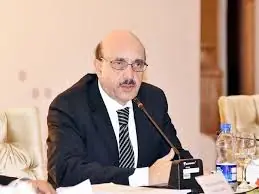
Islamabad, (Parliament Times) : The so-called ‘Core Five Alliance’ cannot materialise as a formal alliance because the economic, military, and strategic interests of the proposed states fundamentally diverge, said Sardar Masood Khan, former Ambassador of Pakistan to the United States and former Permanent Representative to the United Nations, while analysing evolving global power dynamics during a televised interview.
Ambassador Khan explained that although reports and leaks from the detailed version of the U.S. National Security Strategy suggest exploratory division of labour among the United States, China, Russia, India, and Japan, the concept reflects dialogue and selective coordination rather than a structured bloc or alliance. “Alliance is a very big word. These countries do not share common strategic objectives, nor do they trust each other enough to form a unified front,” he said.
He noted that the United States’ latest strategic thinking under President Donald Trump points toward strategic retrenchment rather than global pre-eminence, with Washington increasingly focused on its own hemisphere. Ambassador Khan highlighted that the revised approach echoes a modernised version of the Monroe Doctrine—seeking to prevent large-scale military, technological, or economic encroachment in North and Latin America from other continents while urging Europe to shoulder greater responsibility for its own defence and development.
On China, Ambassador Khan observed that despite toned-down language in the National Security Strategy—where Beijing is framed as an economic and technological competitor rather than an outright enemy—serious fault lines remain, particularly over Taiwan and maritime control in the Western Pacific. “The idea that regional states can collectively contain China is easier said than done,” he said, noting that Southeast Asian countries, despite some disputes with Beijing, lack the appetite or capacity for direct confrontation.
Turning to India, Ambassador Khan stated that New Delhi finds itself increasingly isolated within South Asia, facing strained relations with neighbours including Pakistan, Bangladesh, Nepal, and Sri Lanka. “India has suffered a major military setback this year and is now desperately searching for new technologies, partnerships, and relevance,” he remarked, adding that there is a visible strategic gap between Washington and New Delhi despite recent U.S. efforts to stabilise ties.
Ambassador Khan referred to the December visit of U.S. Undersecretary of State for Political Affairs Allison Hooker to Delhi and Bengaluru as part of attempts to repair U.S.–India relations after a difficult year. However, he cautioned that such engagements do not alter the broader reality of shifting global alignments and reduced American willingness to underwrite global security unilaterally and make India the net security provider in the Indo – Pacific region.
Discussing U.S.–Russia relations, Ambassador Khan said there is potential for rapprochement between Washington and Moscow, driven by pragmatic considerations, including energy markets and the Ukraine conflict. “Improved U.S.–Russia relations may stabilise global oil and gas supply chains, but this will be unsettling for parts of Europe,” he noted.
Concluding his remarks, Ambassador Masood Khan stressed that the emerging global order is not alliance-driven but transactional and interest-based. “What we are witnessing is not the birth of a grand alliance, but selective cooperation in a multipolar system where every major power is recalibrating its priorities,” he said.
Monroe Doctrine Mindset Returns As US Recalibrates Global Role: Masood Khan



Leave a comment