



Sloviansk, Ukraine – When pro-Russian rebels seized the southeastern Ukrainian town of Sloviansk 11 years ago, Raisa said she and her neighbours “treated them well”.
On April 12, 2014, hundreds of armed men led by former Russian intelligence officer Igor Girkin snuck into Sloviansk, making it the first Ukrainian town to be taken over by Moscow-backed separatists.
They fought with police, flew a Russian flag over the town hall, built barricades and roadblocks, and handed out firearms and grenade launchers to jubilant local men who wanted Moscow to annex their region of Donbas.
Russia had just annexed Crimea during a chaotic interregnum that followed the removal of pro-Russian President and Donbas native Viktor Yanukovych after a months-long popular uprising in Kyiv.
“Under Yanukovych, Donbas had lots of privileges, lots of perks,” Raisa, a 72-year-old retired sales manager, said while holding her bike outside a grocery store in Sloviansk.
But 10 weeks of separatist occupation and 11 years of war later, her views – and those of many here – have undergone a U-turn.
Since Russia’s full-scale invasion, which began in 2022, hundreds of thousands of Ukrainian servicemen have been killed as millions of civilians have suffered displacement and been rendered homeless and jobless amid an economic nosedive and galloping prices.
“Now I would have shot [the rebels] myself,” Raisa said, clutching a fist.

Raisa withheld her last name and personal details because she fears reprisals from those who sympathise with and aid Moscow.
Her son is fighting on the front line that lies a mere 15km (9 miles) east of Sloviansk. Her daughter helps the war effort from western Ukraine.
Her teenage granddaughter lives with her and studies from home online because of the danger posed by daily shelling and drone attacks.
“She dreams of entering a university in Kyiv,” Raisa said.
Sloviansk, whose name means “the city of Slavs”, the ethnolinguistic group Ukrainians and Russians belong to, was founded almost four centuries ago as a frontier fortress.
It evolved into an industrial town with a population of 50,000 people employed at factories, balneological resorts, salt and potassium mines, and ceramic workshops.
There were even plans to mine shale natural gas, but a joint project with Shell was mothballed in 2014.
Since Sloviansk was retaken by Ukrainian forces in July 2014, it has yet again become a military stronghold, part of a “fortress belt” in the Donbas that ruined Moscow’s dream of a sweeping takeover of the region on its border.
Sloviansk was a key target of Russia’s largely failed offensive this summer.
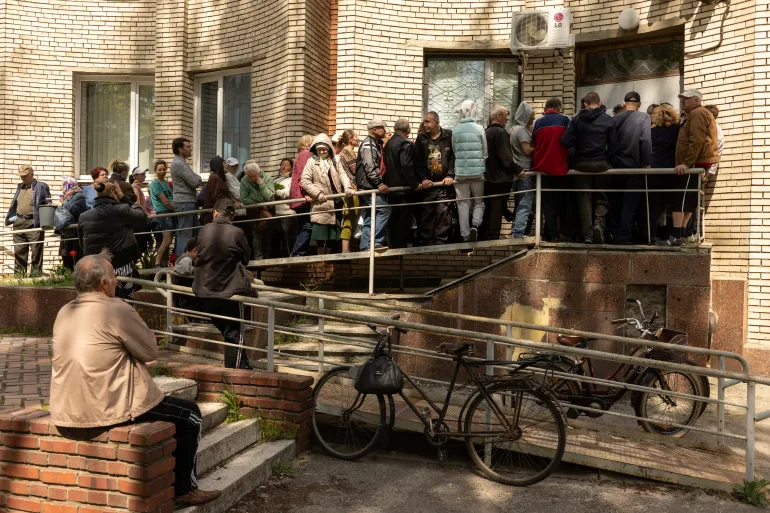
Its streets, shops and cafeterias are filled with burly, stern men in camouflage who often sport tattoos with Ukraine’s national or nationalist symbols and drive around in four-wheeled jeeps the colour of their uniforms.
The sale of alcohol is limited, but the town is studded with gyms and shops selling military gear while ubiquitous advertisements like “Will buy drones in any condition” signal the operation of workshops that repair or assemble unmanned aircraft.
The workshops are clandestine because even though the number of Russia sympathisers has fallen, there are still spies who pass on the locations of military sites to Moscow’s forces.
“Where are intelligence services? Why can’t they arrest the spotters?” Vasily Petrenko, an 82-year-old retired teacher, asked rhetorically, finger-counting the sites that have been hit with drones, missiles or glide bombs in recent months.
At least three spies have been arrested this year alone, according to intelligence services and prosecutors.
Petrenko estimated that among his peers, about 40 percent are pro-Moscow, nostalgic about their Soviet-era youth and awaiting the arrival of Russian troops.
“They sit around drinking beer, asking, ‘When are they coming? When are they coming?’” he told Al Jazeera while leaning on a worn-out wooden cane. “They should just be gathered and reported.”
A glide bomb’s thunderous blast interrupted him mid-sentence.

These bombs, which can fly up to 70km (44 miles) after being dropped, have obliterated entire streets in parts of Sloviansk.
“You don’t know whether you will wake up in the morning or not,” Lydia Bobok, a 37-year-old mother of two, told Al Jazeera in a park next to a Soviet-era monument to the mothers of fallen soldiers.
Such blasts have proved to be the best wake-up call for pro-Russian locals, she said.
Instead of relying on Russian television or pro-Russian politicians who used to frequent Ukrainian talk shows before the full-scale invasion, all they have to do is look around.
“The essence has changed,” she said.
But several locals Al Jazeera approached refused to discuss the war and their political proclivities, repeating: “I don’t know anything about politics. I’m just living my life.”
Sloviansk was the venue of an alleged Russian attempt at stirring up tensions.
On July 12, 2014, the Russian-owned Channel One network ran an interview with a woman who was identified as a “refugee from Sloviansk”.
She claimed Ukrainian servicemen had “crucified” a three-year-old boy in front of his mother who was married to a separatist.
“The mum watched the child bleed to death,” the woman claimed, adding that the servicemen “made cuts to make the child suffer”.
This reporter was in Sloviansk on the day the “interview” aired but failed to find the alleged crucifixion. Independent, now-exiled Russian news outlets Novaya Gazeta and TV Rain, which visited the town, also found no evidence to back up the claims.
During an earlier visit during the separatist-run occupation, this reporter saw crowds of locals thronging the town centre and cheering the rebels sitting on their “trophies” – several armed personnel carriers hijacked from Ukrainian forces.
They incessantly talked about the “Russian Spring”, a Kremlin-coined term after the 2011 Arab Spring uprisings. The term denoted the “inevitable” annexation of Russian-speaking Ukrainian regions in the east and south.
Eleven years later, the first hero of the “Russian Spring”, the separatist Girkin, is serving a four-year jail sentence for “extremism” after lambasting the Kremlin.
In 2022, a court in The Hague sentenced Girkin in absentia to life in jail for his role in the July 17, 2014, downing of a Malaysian passenger plane over Ukraine that killed all 298 people on board.
Sloviansk now seems to have chosen Ukraine’s side.
“Sloviansk has been, is and will be part of Ukraine,” Boris, a military officer who enlisted after fleeing the Russia-occupied part of the southern region of Kherson in 2022, told Al Jazeera. He also requested his surname be withheld out of fear of reprisals from pro-Moscow rebels or spies.
“The fact that it was the cradle of separatism doesn’t mean anything now,” he added with a porcelain-white smile.