




Bulawayo, Zimbabwe – When Lloyd Muzamba was critically injured in a car accident on the Harare–Bulawayo highway in 2023, he needed an urgent blood transfusion to save his life. Despite being admitted at Mpilo Central Hospital, the biggest public health facility in Zimbabwe’s Matabeleland region, a shortage of supplies meant the doctors didn’t have enough for him.
In desperation, Muzamba’s family turned to their only other option – a nearby private hospital that sold them the three pints of blood. But at a cost of $250 per pint, Muzamba – who earned a $270 monthly salary and had no savings – could not afford it.
With time running out, the family had to make a plan. Eventually, Muzamba’s uncle sold a cow for $300 and asked other relatives to contribute the balance.
Two years on, the now recovered Muzamba says the incident has left him psychologically wounded, as he worries about other emergencies when people may need lifesaving blood.
“Three pints can be a small number; others might need more than that. But due to the costs involved, it becomes life-threatening,” said the 35-year-old, who works in a hardware store in Bulawayo.
“I could not get the blood without paying or making a payment plan. It was a painful experience for an ordinary Zimbabwean like me.”
Muzamba’s is not an isolated case.
With ongoing currency woes, rising costs of living and high levels of poverty, desperate Zimbabweans in need of care face life-threatening delays due to financial barriers. This includes blood shortages – despite supplies being free in public health facilities.
Tanaka Moyo, a mother of two in the capital Harare, also experienced the stress of needing to pay for emergency blood supplies during the delivery of her second child.
After excessive postpartum haemorrhaging, the 38-year-old street vendor needed four pints of blood.
Together with her husband, a security guard, she had struggled to raise money for the birth of their child. The sudden need for a blood transfusion was a shocking unplanned cost.
“My husband ran around and borrowed money from a microfinance institution. The interests are steep and conditions stringent, but he had to act quickly,” said Moyo.
“At the hospital, they insisted the blood was free – but it was not available.”
Plaxedes Charuma, a gynaecologist in Bulawayo, says “postpartum haemorrhage is the leading cause of maternal mortality”. The prevalence of the condition means that hospitals should always have supplies on hand to deal with maternal blood loss emergencies that arise, health experts say.

According to the Community Working Group on Health (CWGH), a network of civic health organisations in Zimbabwe, the country faces a high demand for blood transfusions, and those most affected are pregnant women.
“About half a million pregnancies are expected in Zimbabwe, and in some of these, there is excessive blood loss, requiring transfusion of at least three pints of blood,” said Itai Rusike, CWGH’s executive director.
“Maternal mortality in Zimbabwe remains unacceptably high,” Rusike told Al Jazeera. “Timely blood transfusion prevents maternal deaths, which in Zimbabwe stands at 212 women dying per every 100,000 live births.”
‘Free blood for all’
Generally, there are two major types of blood transfusions: allogeneic and autologous. Autologous transfusion refers to self-same blood donation by an individual for their own use later. Allogeneic transfusion, which is the most common in Zimbabwe, involves administering blood donated by one person to another who matches their blood type.
The National Blood Service Zimbabwe (NBSZ) is the body that oversees blood donation and distribution in the country. It operates as an independent not-for-profit entity, but it is mandated by law to collect, process and distribute blood throughout Zimbabwe.
While the Ministry of Health and Child Care is permanently represented on its board of directors, NBSZ functions independently of hospitals and government health institutions. It is not present in every facility, but maintains decentralised distribution from five regional centres: Harare, Bulawayo, Gweru, Masvingo and Mutare.
Historically, patients in Zimbabwe paid for blood, but over the years the government worked on lowering costs – from $150 a pint in 2016 and prior to $50 by 2018.
The government then went a step further in July that year, deciding that blood would be made free at all public health institutions.
“The free blood for all move is going ahead as planned and mechanisms have already been put in place to finance the move, and come July 1 [2018], blood will be available for free,” said then-Minister of Health and Child Care Dr David Parirenyatwa during the June 2018 World Blood Donor Day celebrations.
However, despite the policy, hospitals continue to face shortages.
This May, there was a critical lack of blood in public hospitals, a situation that threatened the lives of thousands of people, the Ministry of Health and Child Care said in a statement. Al Jazeera contacted ministry spokesperson Donald Mujiri to ask about the shortage and the implementation of the free blood policy, but he did not respond to our requests for comment.
NBSZ, meanwhile, said that May’s shortage was due to operational and systemic challenges that disrupted its ability to carry out routine blood collection activities.
“Without timely financial support, we faced constraints in mobilising outreach teams, securing fuel, and procuring essential supplies,” Vickie Maponga, NBSZ communications officer, told Al Jazeera.
“Additionally, the crisis was exacerbated by a seasonal dip in donations, particularly from youth, who make up over 70 percent of our donor base.”
These shortages regularly result in patients on the front line needing to buy blood at private clinics. In most cases, the patient is physically transferred to the private facility for the transfusion, where they pay the costs. In some cases, the patient pays and the private hospital sends the blood to them in the public hospital.

Crucial blood donations
The World Health Organization (WHO) aims to ensure that all countries practicing blood transfusions obtain their blood supplies from voluntary blood donors.
The NBSZ told Al Jazeera that a sustainable blood supply in Zimbabwe depends on cultivating a culture of regular, voluntary donations, particularly among the youth and underserved communities.
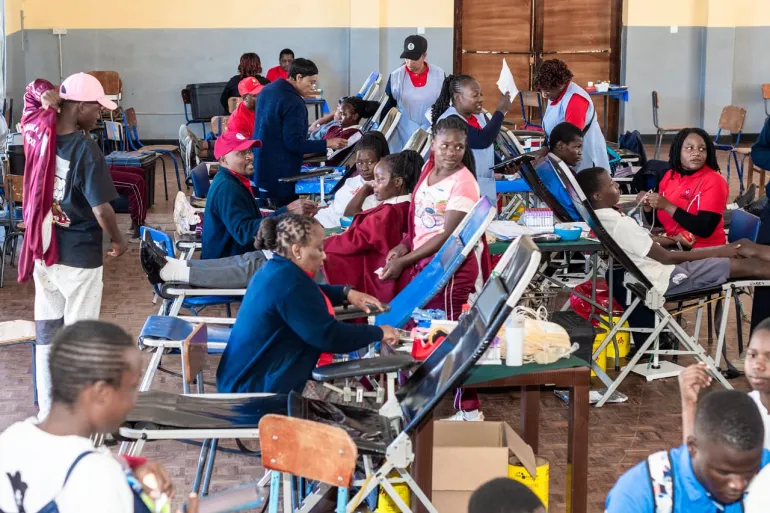
The service has a mobile outreach model, through which it brings blood donation drives directly to schools and communities. To further engage the youth, Maponga said they also started a club that “encourages young people to commit to donating blood at least 25 times in their lifetime”.
“We also integrate blood donation awareness into school programmes and partner with tertiary institutions to maintain continuity post-high school,” she said.
Ivy Khumalo, 32, is one of those who has been donating blood since she was in high school. But she says the lack of blood donation centres around her now limits her ability to give as an adult.
“As a school child, it was [first started] as a result of peer pressure, but I found it fascinating,” Khumalo said. “It was only when I was an adult that I made a personal decision to continue donating out of love to save life and help those in need.”
But since moving from Bulawayo to Hwange, she said, donating blood has become expensive as the nearest centre is in Victoria Falls, over 100km (62 miles) away.
NBSZ says it routinely deploys mobile blood drives around the country. It also says it offers donors incentives.
“Regular donors who meet specific criteria such as having made at least 10 donations, with the most recent within the past 12 months, qualify for free blood and blood products for themselves and their immediate family members … in times of medical need,” explained Maponga.
However, for keen donors like Khumalo, the effort to reach a far-off donation site is a barrier to entry.
“In such circumstances, it is no longer a free donation as I spent money going there. In the end, most of us decide to stay home despite the passion for blood donation,” she said.
CWGH’s Rusike says the NBSZ and Ministry of Health and Child Care must urgently devise innovative and sustainable ways to increase the number of eligible blood donors.
“The government should utilise the Health Levy Fund of 5 percent tax on airtime and mobile data as it was set up to specifically subsidise the cost of blood and assist public health institutions to replace obsolete equipment and address the perennial drug shortages in our public health institutions,” he said. “That money should be ring-fenced and used for its intended purpose in a more accountable and transparent manner.”

Promises and shortages
Authorities say that as of mid-2025, Zimbabwe’s national blood supply is showing good progress, and NBSZ has already collected over 73 percent of its half-year target (the 2025 annual target is 97,500 units).
The blood service also says the Ministry of Health and Child Care plays a central role in both subsidising and overseeing the cost of blood within the public health sector.
“Since 2018, this [free blood policy] is made possible through a government-funded coupon system, which absorbs the full cost of $250 per unit, resulting in zero cost to the recipient [in public hospitals],” said Maponga.
The NBSZ maintains that it operates on a cost recovery basis. It says the entire chain of collecting, processing and distributing a pint of blood costs $245. The agency charges $250, making a $5 profit per pint.
However, prices at some private facilities can reach as much as $500 per pint, Zimbabweans say. This has sparked heated debate on social media, as the high cost remains far out of reach for many people.
“NBSZ does not have regulatory authority over how those institutions price their services to patients,” said Maponga, explaining that while blood itself is donated freely, the journey from “vein to vein” involves a complex and resource-intensive process.
Observers, however, say more can be done to lower the costs of blood transfusions.
“At closer look, the whole chain of blood transfusion can cost less than $150 by strategically deploying available resources, use of financial donor stakeholders like corporates, and also holding the government accountable to fund the whole process,” said Carlton Ntini, a socioeconomic justice activist in Bulawayo.
The issue of free blood in the public hospitals is noble, Ntini said, but without full implementation, it remains a false hope and only benefits the “lucky” few, as shortages are the order of the day.
“In reality, any amount above $50 per pint of blood will still be high to Zimbabweans, and it’s a death sentence,” he said.
Meanwhile, for patients, the cost of essentials only adds to an already stressful situation.
Muzamba was fortunate in that his family did not claim back the money they gave him for his blood transfusion. But Moyo and her husband struggled to settle their $1,000 loan debt, which escalated to $1,400 after interest.
“It psychologically drained me more than the physical pain as I wondered, ‘Where would I get such money in this economy?’” said Moyo. “The government must own up to its promises – it’s not only about being free, but must be accessible.”