



Cape Town, South Africa – Gonda Perez remembers the day South Africa’s apartheid regime bombed a refugee camp in the Zambian capital, Lusaka, during an air raid.
It was in the mid-1980s. Perez was working as a dentist at a local hospital at the time and saw about 10 victims brought in on trucks serving as makeshift ambulances. One of the victims is etched in her memory.
“I stood in casualty, and I watched people come in with wounds, horrible wounds,” said Perez, now 69. “One man that I remember had blood spurting … so obviously it hit an artery or something out of his back… There was blood all over the show and it was really horrible to look at.”
That day, Perez said, the South African Defence Force (SADF) had meant to strike members of Umkhonto we Sizwe (MK), the military wing of the African National Congress (ANC), which led the struggle to end racist white minority rule in South Africa in 1994. But they hit civilians instead.
Perez, who was an ANC member living in exile after fleeing South Africa in the 1970s due to her political activities, witnessed several SADF bombings and raids across regional countries at the time.
She says the Lusaka raid was one of many such “mistakes” committed by the apartheid army due to faulty intelligence. For her – and many observers posting on social media – those bombings also have shades of the Israeli military’s attack on Qatar last week, which aimed to hit the leadership of Palestinian group Hamas, among them senior leaders Khalil al-Hayya and Khaled Meshaal.
Instead, it killed al-Hayya’s son, Humam, as well as an aide, three bodyguards, and a Qatari security officer, in a residential suburb in Doha that is also home to embassies, schools and supermarkets.
The attack came at a time when Qatari officials, who are central mediators in talks between Israel and Hamas, had been trying to broker a ceasefire in Gaza, where Israel has killed more than 65,000 people since launching its war on the Palestinian enclave two years ago. A United Nations inquiry and leading scholars have declared the killings in Gaza a genocide.
Israel’s occupation of the West Bank has also become increasingly violent, and it has launched attacks on neighbouring countries, citing various threats. Over a 72-hour period this month, Israel struck Palestine, Yemen, Syria, Lebanon, Tunisia and Qatar.

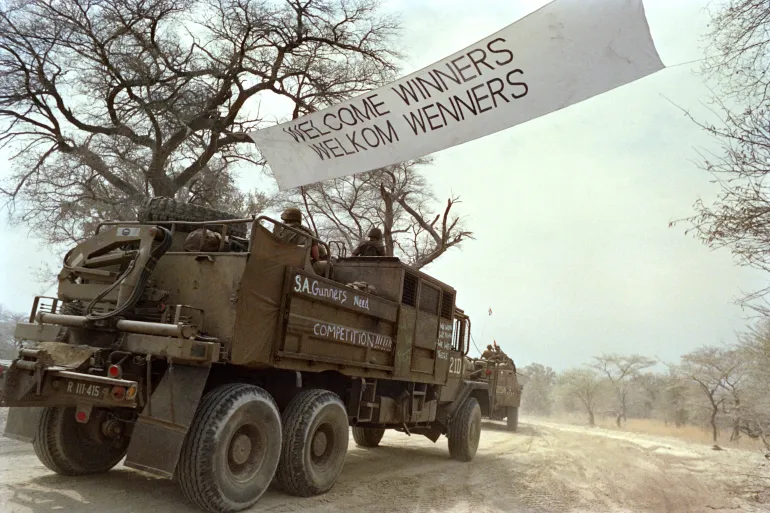
This military escalation is reminiscent of the brutal assaults the apartheid regime launched on its neighbours in the decade or so before its demise, analysts note, as it attacked countries including Zambia, Angola, Namibia, Zimbabwe, Botswana and Mozambique. Like Israel today, apartheid South Africa justified its incursions as necessary to fight its “terrorist” enemies, a claim which helped both countries win support from the United States.
“Similar to Israel’s recent actions, South Africa’s military action abroad relied on targeted attacks against ANC leadership and safehouses, as well as other activists,” said Sonja Theron, a lecturer in security studies at the University of Pretoria. Apartheid assassinations included shootings and bombings, with civilians often caught in the crossfire.
“The disregard for international law, particularly sovereignty, is also similar,” Theron noted.
Over the last two years, Israel has struck and killed Hamas members in Iran and Lebanon, while its military also bombs sites associated with Hezbollah and Yemen’s Houthis, groups it says it targets for their support of Hamas. Civilians have also been killed in these attacks.
Similarly, apartheid South Africa’s cross-border attacks aimed to neutralise the MK and other regional liberation organisations which were granted refuge and support by the “front-line states”, a loose coalition of African countries committed to ending apartheid and white minority rule.
An ‘intimate’ connection
Observers note that the parallels between Prime Minister Benjamin Netanyahu’s government in Israel and the apartheid regime are far from coincidental.
Apartheid was officially instituted in South Africa in 1948, the same year the state of Israel was born. Both nations used religious justification to promote an ethnonationalist ideology, and both defined themselves by their struggle against a similar enemy, with the apartheid National Party and the Zionist state each viewing themselves as an oasis of Western civilisation surrounded by hostile native peoples, researchers say.
In his 2023 book, The Palestine Laboratory, independent journalist Antony Loewenstein writes that after South African Prime Minister John Vorster, a Nazi sympathiser, visited Israel in 1976, the government yearbook carried the following message: “Israel and South Africa have one thing above all else in common: they are both situated in a predominantly hostile world inhabited by dark peoples.”
These affinities resulted in a tight alliance built around defence, with mineral-rich South Africa supplying the capital and Israel the technology.

But Israel also took inspiration from South Africa’s harsh racial segregation policies, in particular the “Bantustan” reserves that forced Black South Africans into “homelands”. These ethnic states served as the blueprint for the 165 “enclaves” Israel established in the occupied West Bank, cutting up Palestinian land, according to Loewenstein.
At the heart of the relationship were weapons, though. Loewenstein writes that South Africa and Israel signed a secret security agreement in April 1975, which laid the foundation of their relationship for two decades.
Loewenstein quotes Alon Liel, a former Israeli ambassador to Pretoria in the 1980s: “After 1976, there was a love affair between the security establishments of the two countries and their armies. We were involved in Angola as consultants to the army. You had Israeli officers there cooperating with the army. The link was very intimate.”
So intimate, in fact, that Israel contravened United Nations Security Council sanctions imposed on apartheid South Africa, while also furthering secret cooperation around building nuclear capabilities. Loewenstein reveals that South Africa reportedly even allowed Israel to test nuclear weapons in the Indian Ocean in 1979, which Israel denies.
Emboldened by its modern weaponry, South Africa launched its series of wars in regional countries in the 1970s and 1980s. In many ways, the swirl of battles in the front-line states back then was a proxy for the broader Cold War standoff.
Civil wars were raging in Angola and Mozambique following their independence from Portugal, with Angolan MPLA government forces backed by Cuba and the Soviet Union fighting against UNITA rebels backed by Pretoria and the US. In Mozambique, the ruling FRELIMO – which was backing liberation movements in the region – fought RENAMO, a group supported by apartheid South Africa and the white minority-led Rhodesia (which became Zimbabwe in 1980 following independence). Meanwhile, Namibia’s South West Africa People’s Organisation (SWAPO) was engaged in an independence war with South Africa.
An estimated 1.5 million people died between 1980 and 1988 as a result of deaths from direct conflict, disease, famine and disruptions in health services. Angola and Mozambique, where South Africa had backed rebels to fight against pro-democracy liberators, bore the brunt of the conflict.
The economic cost of the destruction of infrastructure, much of it due to South African aggression, exceeded $60bn over this period.

‘Increasingly unpopular, politically costly’
After decades of apartheid rule and regional tensions, analysts say the goodwill of other liberation movements in Southern Africa towards the ANC was wearing thin, as South Africa’s military and economic prowess exhausted its smaller rivals.
But at the same time, Pretoria was drawing increasing international condemnation as its brutal conflicts abroad and its crackdown on civilian uprisings at home became indefensible, resulting in US sanctions via the Comprehensive Anti-Apartheid Act in 1986.
For many observers, this outrage mirrors the growing opposition to Israel, especially as images emerge daily of Palestinians in Gaza killed by Israeli bombs or starved because of food supplies being blocked.
Last Tuesday’s attack on Doha also appeared to deepen international opposition to Israel’s increasingly combative actions. Even traditional Israeli allies joined in the criticism, including Germany and the US.
At the same time, Spain and the European Union announced a series of measures against Israel, including an arms embargo, sanctions on “extremist Israeli ministers” and settlers, and a suspension of bilateral support.
“The United States’ relationship with apartheid South Africa constantly varied considerably depending on the administration, with the policies of Nixon, Ford, Carter, and Reagan differing in meaningful ways. We see similar geopolitical developments constantly changing the playing field when it comes to Israel and Palestine,” said Lazlo Passemiers, a historian based at the University of the Free State in South Africa.
“What can be said with greater certainty is that Israel’s continued reliance on military aggression across the region, and its acts of genocide in Gaza, are making it increasingly unpopular and politically costly for other countries to provide it with open support.”
Qatar’s Prime Minister Sheikh Mohammed bin Abdulrahman bin Jassim Al Thani has called for a collective response to Israel’s attack on Qatar, warning that “the entire Gulf region is at risk.”
However, experts point out that despite the criticism of Israel’s actions, Netanyahu is unlikely to back down from his military ambitions as long as he enjoys the support of President Donald Trump’s government in Washington.

The key difference between Israel now and South Africa then, according to analysts, is that Israel is of far greater strategic value to the US than South Africa was during the Cold War era, and therefore enjoys almost unlimited support from the world’s superpower.
Furthermore, the US’s decision to impose sanctions on South Africa in the 1980s required bipartisan compromise to overturn President Ronald Reagan’s veto of the bill – a scenario which is unlikely in the sharply divided political climate that currently prevails in the US.
Demand change ‘from within Israel’
In the democratic era, South Africa’s ruling ANC has been fiercely pro-Palestine since its first electoral victory in 1994. By asserting its support for Palestine, President Cyril Ramaphosa, as the current head of the ANC, has continued a long legacy of collaboration.
Shortly after his release from prison in 1990, Nelson Mandela made it clear that the ANC had no plans to distance itself from the Palestine Liberation Organization (PLO) or the Palestinian cause as a whole, despite the PLO being labelled a “terrorist” organisation by the US and Israel. The ANC has maintained its support for Palestinian independence ever since.
In 2018, South Africa withdrew its ambassador from Israel after the Israeli army killed dozens of peaceful protesters in Gaza, and in 2021, it campaigned against Israel being granted observer status in the African Union.
In December 2023, Ramaphosa’s administration lodged a case with the International Court of Justice (ICJ), accusing Israel of genocide in Gaza. The country’s parliament has also voted for cutting all ties with Israel, though the government has not followed through on that call.
Despite criticism from activists that it is not doing enough to hold Israel accountable, the South Africans insist the ICJ case is the optimal channel to register their protest.
Meanwhile, as the attack on Qatar leaves the prospect of a peace deal between Israel and Hamas in tatters, analysts say the best hope of bringing the two sides together could lie in the South African example.
The major lesson from the downfall of apartheid was that it relied on both external pressure – including boycotts, sanctions, support for liberation movements, and international opposition to Pretoria – as well as domestic pushback, analysts said.
“Demands for change from within Israel will be necessary to bring about an end to Israel’s oppression and violence,” said Theron.

Meanwhile, for Perez, watching the war unfold in Gaza has triggered memories of her own trauma during the anti-apartheid struggle.
She recalls the constant raids across the border into Botswana to abduct anti-apartheid fighters living there, a letter bomb ripping off the hand of a young comrade in Zambia, and the several times she had to relocate to escape apartheid forces, often crawling along the ground as she made her getaway.
However, she says what’s happening in Gaza is a far cry from her personal ordeal, and it’s something she hopes Israel can be held accountable for.
South Africa must do more, Perez feels, including cutting off all trade relations with Israel and lobbying to have it kicked out of global bodies like the football federation FIFA and the Olympics.
“We need to throttle them economically with sanctions [as was done to apartheid South Africa], and then we will reach that point where Israel will be forced to come and negotiate and be forced to consider a free Palestine,” she said.
“There’s a lot more work to be done.”