




New Delhi, India – As the Taliban returned to power in August 2021 following the chaotic withdrawal of US forces, which triggered the collapse of the Western-backed government in Kabul, India was forced to shut its embassy and hurriedly pull out its diplomats and citizens.
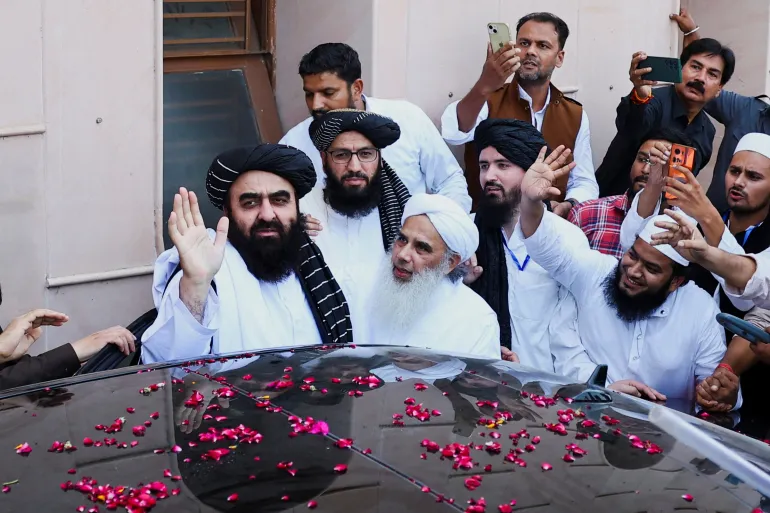
More than four years later, Prime Minister Narendra Modi’s Hindu nationalist government has rolled out a red carpet for an Afghan delegation led by the Taliban administration’s Foreign Minister Amir Khan Muttaqi in the capital, New Delhi.
The Afghan foreign minister’s weeklong trip – the first official visit by a Taliban leader – is being billed as groundbreaking. Muttaqi, who remains on the United Nations sanctions list, arrived in India after receiving a temporary travel exemption from the world body.
India’s reset with the Taliban, experts say, is part of a policy of pragmatism, as New Delhi aims to counter Pakistani influence in Afghanistan, whose relationship with Pakistan, India’s arch foe, has been strained over cross-border attacks.
Some analysts, however, say India’s hosting of the Taliban leaders gives legitimacy and a de facto recognition to the Taliban administration, which has been struggling to boost its diplomatic legitimacy.
So, why is India embracing the Taliban now? What happened at their meeting – and what is New Delhi expecting from the Taliban? What is in it for the Taliban?

What happened during the India-Taliban meet?
Muttaqi, accompanied by Afghan trade and foreign ministry officials, is meeting Indian officials to discuss diplomatic, trade, and economic ties during his visit.
After he met Foreign Minister Subrahmanyam Jaishankar on Friday, New Delhi said it will reopen its embassy in Kabul.
“Closer cooperation between us contributes to your national development as well as regional stability and resilience,” Jaishankar said. He also affirmed India’s “full commitment to the sovereignty, territorial integrity and independence of Afghanistan”.
Muttaqi has called India a “close friend”. In a joint statement, New Delhi and the Taliban committed to maintaining “close communication and continue regular engagement”.
The Afghan leaders also invited Indian companies to invest in its mining sector, which the statement said “would help strengthen the bilateral trade and commercial relations”.
New Delhi also stated that it is committed to furthering its humanitarian assistance and other development projects in Afghanistan, one of the world’s poorest countries.
Modi’s government also facilitated Muttaqi’s visit to Deoband, in Uttar Pradesh, which hosts the Darul Uloom Deoband, one of the most influential Islamic seminaries in South Asia.
On Monday, Muttaqi announced that direct flights would soon start between Kabul and Indian cities, including Amritsar in Punjab.
Why is India embracing the Taliban now?
Historically, India has viewed the Taliban as a proxy for Pakistan’s intelligence agencies. Many Taliban members had studied in conservative religious schools in Pakistan, which also provided crucial support to the mujahideen movement against the Soviet Union in the 1980s. It was from the mujahideen that the Taliban emerged.
India shuttered its Kabul embassy in 1996 when the Taliban first took control of Afghanistan. Instead, India backed the Northern Alliance – Afghan groups fighting the Taliban – providing diplomatic support, aid, and training to counter Pakistani influence and protect its regional interests. The Northern Alliance also had backing from other countries, primarily Iran and Russia.
Pakistan was one of only three countries that recognised the Taliban administration until it was dislodged from power in a US-led invasion in 2001.
When the US and NATO forces invaded the country and the Taliban lost power, India reopened its embassy but continued to treat the Taliban as a Pakistani ally. India blamed the Taliban and its allies for a series of bombings at its diplomatic missions across Afghanistan.
Islamabad, meanwhile, was accused by US leaders of giving safe haven to Taliban leaders and fighters as the group waged a deadly armed rebellion against the US-led NATO forces for 20 years.
After Kabul’s fall in 2021, when the US-led forces withdrew and the Taliban captured power, India once again shut its embassy and consulates in Afghanistan, stopped issuing visas to all Afghans, including students, traders, and even former government officials.
India started making diplomatic overtures to the Taliban a year after the group’s return to power, re-establishing diplomatic presence in the country, tasked with overseeing the distribution of humanitarian aid. In the past two years, India has allowed the Taliban to quietly take over the Afghan consulates in Mumbai and Hyderabad.
Indian officials and diplomats have also held several high-level engagements abroad. In January this year, Muttaqi also met India’s Foreign Secretary Vikram Misri in Dubai, the United Arab Emirates.
At the same time, Pakistan’s ties with the Taliban have plummeted. Islamabad has accused Afghanistan’s rulers of sheltering armed groups, including the Pakistan Taliban, or TTP, which have carried out dozens of deadly attacks on Pakistani soil in recent years. The Taliban deny those charges.
It is in that changed regional geopolitical landscape that India is welcoming Muttaqi, said analysts.
“The costs of avoiding engagement with the Taliban [by ceding a regional ally to Pakistan] in the past compelled the Indian government to strengthen relations with Kabul this time,” said Praveen Donthi, a senior analyst at the International Crisis Group in New Delhi.
“It’s a strategically vital relationship that can’t be ignored on ideological grounds,” Donthi said, referring to the lack of common ground between the conservative Taliban and the Hindu nationalist government in India. “Or left to India’s primary strategic rivals to exploit,” he added, speaking on the Chinese exchanges and investment with Kabul.
“The visit demonstrates India’s willingness to rise above ideological concerns and optics and to engage pragmatically with the Taliban,” Donthi told Al Jazeera.
Gautam Mukhopadhaya, a retired Indian diplomat and former ambassador to Afghanistan, told Al Jazeera that, unlike the Taliban of the 1990s, when Pakistan wielded complete control over it, regional dynamics have changed.
“The new Taliban is slightly more worldwide [in its overview] and more savvy. And they have to see the larger interests of Afghanistan,” said Mukhopadhaya.
India has shared deep-rooted cultural and trade ties with Afghanistan for centuries, dating back to the Mughal era. “That sense of kinship with India has always been there,” Mukhopadhaya said. “And India has goodwill on the ground due to its humanitarian assistance. Hindustan, as a concept, is a big thing in the Afghan mind.”
And India’s non-engaging phase with the Taliban’s first rule was an “aberration” in bilateral ties, added the former diplomat, who reopened the Indian embassy in Afghanistan after the Taliban’s removal from power in 2001.

What is India expecting from the Taliban?
To India, it is clear that the Taliban regime is not going to go away soon, said Ajai Sahni, executive director of South Asia Terrorism Portal, a platform that tracks and analyses armed attacks in South Asia. “You can’t simply walk away because the regime is not to our liking.”
“You have to deal with the reality of the political dynamics in the region,” he added. “And this situation demands greater outreach [to the Taliban] on India’s part and establish relations with regimes that are willing to go along with the Indian position in the subcontinent.”
Kabul’s growing conflict with Islamabad is an important factor in India’s calculations.
The tensions spilled over the weekend as Pakistan and Afghanistan traded heavy fire in the border areas. Dozens are believed to have been killed on both sides. The fighting coincided with Muttaqi’s ongoing visit to India.
The deportation of tens of thousands of Afghan refugees by Pakistan has further strained the ties between the two neighbours.
In terms of regional relationships, Afghanistan was also among the few countries that strongly condemned the Pahalgam attack in Indian-administered Kashmir in April earlier this year. The attack that New Delhi blamed on Pakistan – a charge it denies – brought the South Asian rivals to the brink of an all-out war in May as they traded missile and drone attacks.
Mukhopadhaya, the former envoy, says the Taliban and India have a common enemy. “We both have grievances and problems with Pakistan,” he added. “That also makes us natural allies.”
In their joint statement, the Indian Ministry of External Affairs expressed “deep appreciation” to the Taliban for its “strong condemnation of the terrorist attack in Pahalgam … as well as for the sincere condolences”.
“Both sides unequivocally condemned all acts of terrorism emanating from regional countries,” the statement noted, without naming Pakistan.
Addressing India’s security concerns, the Taliban foreign minister also “reiterated the commitment that the Afghan government will not allow any group or individual to use the territory of Afghanistan against India”.

What does the diplomatic engagement mean for the Taliban?
The meeting in New Delhi means a world for the Taliban and its standing both at home and abroad, said Sahni, as the group has been making efforts for diplomatic recognition. The Taliban administration is only recognised by Russia, and several senior leaders remain under UN sanctions.
While rolling out the carpets for the Taliban leader, the Modi government is facing uncomfortable questions at home, including on women’s rights, broader human rights violations, and the killing of Reuters photojournalist Danish Siddiqui in July 2021.
The exclusion of female journalists from Muttaqi’s first news conference at the Afghan embassy in New Delhi last week caused an uproar, with opposition leaders and journalists slamming the government for its silence on the issue.
The next day, the Afghan officials conducted another news conference that included women, seated in the front row of seats.
Visiting Taliban officials have used the Afghan embassy in New Delhi, which still flies the flag of the previous Western-backed government, for these events, but do not have control over its premises since India has not formally recognised the Taliban government as yet.
Gaining that recognition and control of the embassy would be a major diplomatic victory for the Taliban.
For Afghanistan, deeper engagement with India could open doors to trade, education, and healthcare partnerships, analysts noted, as reflected in the joint statement put out by the two ministries. Last year, the annual bilateral trade was nearly $900m.
Muttaqi on Monday also met a delegation of Afghan Sikhs and Hindus, who had left Afghanistan over the past few decades and are currently living in Delhi. Muttaqi told them they were welcome to return and restart their businesses.
Thousands of Afghan students study in Indian universities, traders depend on Indian markets, and Indian-backed projects — from hospitals and dams to humanitarian aid — have been lifelines for many Afghan communities.
“The world may not understand, but for the Taliban, [being courted by India] is a big thing,” said Sahni. “There are not too many people who can give them the legitimacy, trade, and humanitarian assistance, alongside diplomatic respectability.”