



The Islamabad High Court (IHC) on Thursday restrained the Capital Development Authority (CDA) from cutting trees in the federal capital until February 2 and sought a detailed report on the ongoing tree-felling drive, amid allegations of large-scale environmental damage.
IHC’s Justice Khadim Hussain Soomro issued the directives while hearing a petition filed by Muhammad Naveed Ahmad of the Centre for Justice and Rights, which invoked Article 199 (jurisdiction of high court) of the Constitution.
Advocate Muddasir Latif Abbasi appeared as the petitioner’s counsel, while Assistant Attorney General Sarfraz Rauf was present on the state’s behalf.
At the outset of the hearing, Advocate Abbasi contended that massive tree felling was being carried out across Islamabad in violation of rules and regulations.
He argued that the indiscriminate cutting had led to serious environmental changes, posing dangers to public health and ecology, and amounted to a violation of the Pakistan Environmental Protection Act 1997 (PEPA).
At one point, Justice Soomro summoned the AAG to the rostrum and questioned the government side, asking why trees were being cut despite existing environmental safeguards.
Taking serious notice of the matter, the court ordered the CDA to immediately stop all tree-felling activities until the next hearing.
Notices were issued to the CDA, the Pakistan Environment Protection Agency (Pak-EPA) and the climate change ministry, directing them to submit a detailed “para-wise” response and comprehensive report at the next hearing.
Subsequently, the court adjourned the hearing until February 2.
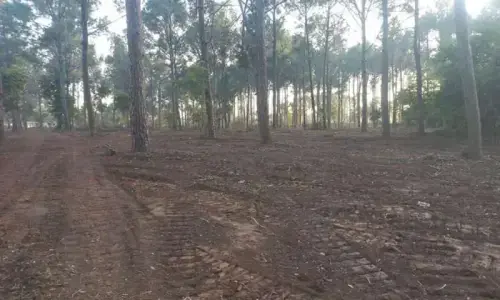
Recently, a large-scale tree removal drive took place in at least three locations in the Islamabad Capital Territory (ICT), including around Shakarparian, sparking widespread public criticism.
Minister of State for Interior Tallal Chaudhry, speaking in the National Assembly on Tuesday, stated the figure as 29,115 trees, attributing it to three “possible causes”, and affirmed that a greater number of trees would be planted in the coming months.
While the CDA had earlier maintained that only paper mulberry trees were removed as they had been causing pollen allergies, WWF-Pakistan found that the action was also linked to infrastructure development in multiple locations.
According to the petition, the actions of the authorities contravened PEPA, the Islamabad Wildlife Ordinance 1979, and the Master Plan of Islamabad, which designates Shakarparian as a protected green area.
It was further asserted that no public hearing was conducted as required under environmental law and that the Pak-EPA failed to take timely action.
The petition also criticised the Ministry of Climate Change and Environmental Coordination, stating that instead of intervening, the minister publicly justified the tree cutting, claiming it was carried out in line with court orders.
The petitioner alleged that thousands of mature trees were cut during late 2025 and early 2026, causing what he termed “grave and irreversible environmental harm”.
IHC urged to fix responsibility at ‘highest levels’ within CDA
The petition, a copy of which is available with Dawn, made several requests before the IHC.
The petitioner urged the IHC to direct the CDA to produce the “official record of the tree-cutting operations in Shakarparian, H-8 and other areas, including who recommended it; who approved it; on what legal or policy basis; and any environmental impact assessments or notifications issued”.
He requested the court to fix responsibility for the tree-cutting at the “highest levels” within the CDA, and direct “appropriate and exemplary penal action” under relevant laws, including Pepa and the Pakistan Penal Code 1860.
Ahmad also called for Pak-EPA and the climate change ministry to be held accountable for “not having acting in the matter in time or at all”, and for them to face penal action.
The complainant urged the IHC to impose an “immediate ban on the cutting of all trees in Islamabad”.
He sought a high-powered judicial commission — headed by a retired IHC or Supreme Court judge — to investigate the “recent and ongoing violations of the Master Plan of Islamabad, including unauthorised tree cutting and encroachments”, and submit a report with recommendations within 90 days.
The petitioner urged the IHC to order the CDA to “compensate for the cut trees by immediately transplanting mature, grown-up native trees in the affected areas and planting additional new trees of appropriate age and size at a ratio of at least ten for every one tree removed”.
Ahmad also called for a detailed implementation report on the recommendations of the 2015 Dr Parvez Hassan Report in similar environmental cases, asking the court to “identify violations, fix responsibility and direct exemplary penal action”.
The petitioner also sought the establishment of an “impartial, autonomous, and fully empowered body” — which would comprise experts, civil society representatives and judicial nominees — for approving any future tree-cutting campaigns in cases of “genuine necessity”.
Objections raised over infrastructure projects
Serious concerns were also raised over the construction of a monument in Sector H-8 along the Islamabad Expressway.
The petitioner alleged that hundreds of decades-old native trees were cut for the project without any justification related to pollen mitigation.
He pointed to an apparent lack of transparency in site selection and sought directives to the CDA to justify to the court’s satisfaction as to why the monument could not be built in an existing park or public place.
Ahmad further requested the court to order the CDA to withhold further construction of a new cricket stadium and convention centre until the satisfaction of the IHC or “any commission or entity empowered by the honourable court in this behalf”.
He sought a moratorium on “all current and upcoming infrastructure projects in Islamabad until the establishment of an independent oversight mechanism to review and approve such projects in the context of environmental protection and the Master Plan”.
He urged the IHC to issue an injuction “stopping all further construction and civil works at the H-8, and direct that the project be shifted to another appropriate location that does not involve environmental degradation, thereby setting a precedent that no tolerance […] will be shown even after a project is launched, and will not be accepted by superior courts as fait accompli”.
The petition noted that indiscriminate tree cutting had been carried out in sectors H-8, H-9, F-9 Park, Chak Shahzad and near Zero Point, with some of the activity linked to infrastructure projects such as park upgradation, road construction and the establishment of a bus depot.