



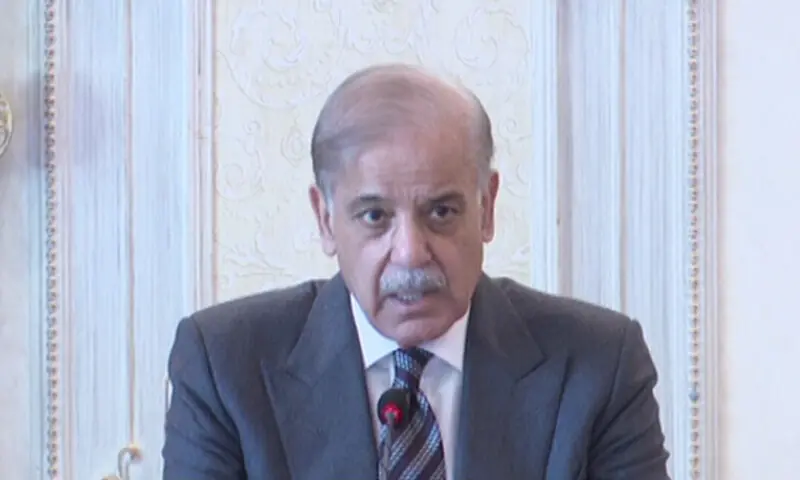
Prime Minister Shehbaz Sharif said on Tuesday that he was reiterating his offer for talks with the opposition but also emphasised that dialogue between the two sides could only proceed on “legitimate matters”.
The proposition by the premier was made during a federal cabinet meeting in Islamabad, where he referred to news reports of the opposition PTI and its “companions talking about dialogue“.
He recalled that he had previously invited the opposition for talks on multiple occasions, including in the assembly.
“If they are ready for this, the government of Pakistan is definitely ready,” he said, adding that harmony among all political parties was necessary for the progress and prosperity of the country.
However, he continued, there should be no “blackmailing” under the guise of talks and dialogue could only move forward “in light of legitimate matters”.
The need for dialogue between the government and the opposition has been stressed as Pakistan continues to face political and economic crises.
On December 21, the second and last day of a “national conference” held by opposition alliance Tehreek Tahafuz Ayeen-i-Pakistan (TTAP), the participants had agreed that the door to dialogue must never be closed in a democracy.
They were of the opinion that in light of the ongoing national crisis, the country needed a new Charter of Democracy more than ever before.
The same day, political leaders, including ruling PML-N stalwarts, from across the spectrum called for dialogue and restraint to achieve stability in the country, saying that political confrontation was causing instability and violence.
This call for reconciliation among political actors was made at the Khawaja Rafique Shaheed reference in Lahore.
Speaking on the occasion, Law Minister Azam Nazeer Tarar urged a new national political charter rooted in tolerance and dialogue while PM’s Adviser Rana Sanaullah stressed that political stability could only be achieved through restraint, mutual respect and sustained dialogue.
The matter of talks between the opposition, mainly the PTI, and the government has been in the news since last year.
After more than a year of heightened tensions, the two sides had commenced dialogue in the last week of December 2024 to bring down political temperatures. But despite weeks of negotiations, the dialogue process stalled on major issues — the formation of two judicial commissions to probe the protests of May 9, 2023 and Nov 26, 2024, and the release of PTI prisoners.
The Shehbaz government once again extended a dialogue offer to the opposition PTI in February this year as National Assembly (NA) Speaker Ayaz Sadiq insisted that the option of talks had never been dropped.
However, a day after the PM made the offer, the PTI refused it, with party leader Asad Qaiser asking how they could enter a dialogue with the government when the rulers had stepped up the crackdown on the PTI.
Qaiser alleged the government had started raids to round up the PTI workers, and dozens of them had reportedly been arrested across the country.
In early August, the dialogue offer was again extended by government ministers and Speaker Sadiq during a debate on the Kashmir issue in the NA.
The PTI members welcomed the offer for talks but questioned the government’s authority to initiate dialogue.
More recently, Sadiq reiterated his offer on November 13 to facilitate a dialogue between the government and the opposition parties.
The offer was made by the speaker at a time when the opposition members belonging to the PTI were protesting in the assembly during the passage of the 27th Constitutional Amendment Bill.
He had again ostensibly made an offer of talks to the opposition, telling a group of parliamentarians visiting him on November 28 that dialogue was the way to resolve issues.
On December 6, after a fiery speech in the Senate by a PTI-backed lawmaker, deploring the absence of rule of law and an unannounced ban on meetings with incarcerated former prime minister Imran Khan, the ruling party once again held out an olive branch to the PTI, reassuring it that all issues could be resolved through dialogue.
Speaking in the upper house of parliament, Sanaullah said the PTI had always rejected the path of negotiations, even though all issues could be resolved through dialogue rather than deadlock.
He said the government was ready to hold a dialogue with the opposition to take the country forward, but the PTI leadership remained unwilling.
Without naming the military establishment, the adviser to the premier said, “Those who they want [to have] dialogue [with] are not ready for talks with them.”