




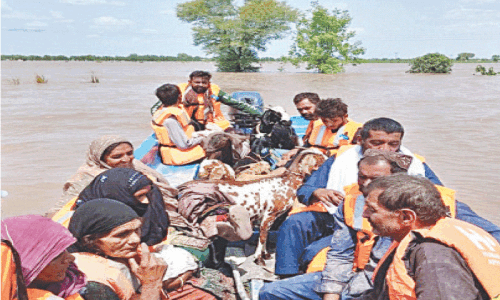
• Protective embankments under pressure as Chenab continues to rise; more than 400,000 relocated
• Experts fear catastrophe at Head Muhammadwala
• High flood warning for Kasur, Okara, Bahawalnagar and other cities
• Over 85 Sialkot villages cut off since Aug 26
• Fears of urban flooding as more rain expected from today
• Homes washed away, farmland destroyed in GB’s Deral valley
LAHORE: As the water level continued to rise in the Chenab River at Head Muhammadwala and Sher Shah bridges, the urban centres of Multan and Muzaffargarh were facing a grave threat due to the extremely high-level flood that had not subsided despite the passage of 36 hours.
The National Disaster Management Authority also issued a “high flood” warning for Kasur, Okara, Pakpattan, Burewala, Arifwala and Bahawalnagar, as water levels continue to increase in the Sutlej River.
Multan Deputy Commissioner Waseem Hamid Sindhu said that the flood level in the Chenab River was continuously rising, due to which water had reached the Akbar Flood Bund and the Sher Shah bridge, inundating several villages.
“The situation is likely to worsen due to the joining of the Ravi River and the Chenab,” DC Sindhu said, adding that the water was above 414 feet at Greywala Chowk and showing a rising trend. He said the decision to breach the dyke at Head Muhammadwala would be taken if the 417-feet threshold was crossed. The DC said that a record 400,000 people were relocated to safer areas in the district.
Multan Commissioner Amir Karim Khan said that the water gauge at Head Muhammadwala was recorded at 413.66ft — just a few feet short of the critical level of 417ft. He said the decision to breach the embankment would be based on the water flow speed, intensity, and other factors.
‘Non-technical and incorrect information’
However, the experts appeared alarmed by the situation at Head Muhammadwala, claiming that the critical level was actually lower than 417 feet.
The former irrigation department experts said the technical committee, comprising the irrigation department and other departments, provided non-technical and incorrect information to the administration regarding the breaching section. Accordingly, the water level at Head Muhammadwala was set at 417 (above sea level), based on the 1992 flood flow.
However, the bridge had not been constructed at the time and the area was an open floodplain, with no controlled area of the bridge obstructing the flood flow, they said, adding that the 417-feet threshold would increase the pressure on the Nawabpur and Akbar Flood embankments.
Since the government did not reassess the critical level at this gauge following the construction of the bridge, the situation at this head was precarious. The slow discharge from Head Muhammadwala caused flooding from Jewana Bangla to Head Muhammadwala, they said, adding that the Ravi flood flow was also stagnant at Sidhnai Headworks for the same reason.
They urged the authorities to review the critical level to save Multan before the flood moving from Chiniot towards Trimmu Headworks could merge with the current flood flow.
According to PDMA, the Chenab at Marala Headworks was flowing at 117,369 cusecs. Khanki Headworks was reporting a steady flow of 248,840 cusecs, while Qadirabad Headworks was steady at 385,228 cusecs. The flow at Chiniot Bridge was steady at 554,998 cusecs. The water level at Rivaz Bridge was 520.50 feet; it was rising but remained below its maximum of 526 feet. Trimmu Headworks had a steady flow of 239,545 cusecs. At Head Muhammadwala, the level was steady at 414.00 feet against a maximum of 417.50 feet. The Sher Shah Bridge level was steady at 393.40 feet against a maximum of 393.50 feet.
Indian dams threat
Addressing a press conference, PDMA chief Irfan Ali Kathia said that the water level in Indian dams was continuously rising. He said that New Delhi had issued seven warnings to Pakistan about opening dam gates and three in the last 24 hours. He said that Ravi, Sutlej, and Chenab would be affected after the release of more water from Indian dams.
Mr Kathia said that the situation at Head Sindhnai along the Ravi was “problematic” as water levels continued to increase at Jassar as well as Shahdara Headworks. He attributed the increase in the water level to the ‘backwater effect’. The DG said that as many as 3.8 million people had been safely evacuated from flood-affected areas in Punjab. “Massive evacuations have been carried out in the past 24 hours, mainly in Toba Tek Singh, Pir Mahal, Kabirwala, and Khanewal.”
Sialkot villages cut off
As many as 85 villages of Bajwat, a rural area situated near the Pak-India border, remained cut off from the Sialkot district. Flash floods and incessant rainfall in the catchment area have swept away a bridge.
The residents had been without electricity since August 26 — the day when the devastating rain of over 500mm submerged Sialkot and adjoining areas, including Bajwat, and some other villages in neighbouring Chaprar town. Though the local administration temporarily constructed a Bailey bridge to connect Bajwat with Sialkot, recent flash floods in Tavi and Chenab rivers eroded its foundations, rendering it unusable.
“…Bajwat’s 85 villages are disconnected….despite the fact we have tried hard to restore mobility of the people,” Rana Iqbal Harnah, an MPA from Sialkot, told Dawn.
Sialkot Deputy Commissioner Saba Asghar Ali said that Bajwat has some local markets from where the people were meeting their needs to some extent. She said the administration was making all efforts to help the residents, adding that they were using bikes to access the area as boats could not be used due to the uneven terrain.
A local official, on condition of anonymity, said the situation was dire, particularly due to a prolonged power outage. Chaprar town and its three villages have also been affected by floods and rains,” said Muhammad Nafees, the Chaprar union council secretary, situated near Bajwat. Mr Nafees said the supply of various items from Sialkot to Bajwat continued to be disrupted due to the situation, leading to a shortage of essentials.
Flash flood in GB
Meanwhile, a flood ravaged Deral Valley in Gilgit-Baltistan’s Diamer district, damaging at least 20 houses and farmlands, Dawn.com reported.
Deral Assistant Commissioner Waseem Abbas told Dawn.com that the flood occurred at 6am due to heavy rains, which engulfed the Gamari area. “As a result of the floods, 20 houses were damaged, of which five were completely demolished,” he said. “In addition, crops and trees were also damaged.” GB government spokesperson Faizullah Faraq told Dawn.com that timely information was received from the villagers, which saved dozens of lives.
Another rain spell
Separately, another monsoon spell from September 6 to 9 is expected across the country, including the Punjab districts of Sialkot, Multan, and Khanewal.
In Balochistan, most districts are set to receive “rain-wind/thundershower” on Sept 7-9 with occasional gaps.
In Kashmir, rain-wind/thundershower, with isolated heavy falls, is expected from September 6 (evening) to 8 with occasional gaps, whereas Khyber Pakhtunkhwa cities will receive rainfall from Sept 7 to Sept 9.